NeuroStar Advanced TMS is a non-medication, non-invasive treatment for depression and OCD. No anesthesia. No downtime. You drive yourself home. The most clinically studied TMS system in the U.S., with 15+ years of real-world outcomes behind it.
NeuroStar Advanced TMS
The most clinically studied TMS system in the U.S. · FDA-cleared for depression & OCDTMS stands for Transcranial Magnetic Stimulation. The treatment uses precisely targeted magnetic pulses — similar in strength to an MRI — to stimulate areas of the prefrontal cortex that become underactive in depression and OCD.
The pulses pass through your skull and gently activate the neural circuits involved in mood regulation. Over a course of treatment, those circuits rebalance and patients start feeling like themselves again.
What it doesn't do: no medication, no anesthesia, no sedation, no recovery time. You walk in, sit in a chair for 3–20 minutes, and walk back out. Most patients return to work or daily life the same day.
We use the NeuroStar Advanced TMS system — the most clinically studied TMS system in the U.S., backed by 15+ years of real-world data and multiple multi-site studies (O'Reardon 2007, Janicak 2008/2010, George 2010, Carpenter 2012, Dunner 2014, and others).
Foundational FDA trials and the independent NIMH-sponsored George et al. 2010 study established TMS as a durable, evidence-based treatment for major depressive disorder. Follow-up data showed clinical benefit holds up over 6- and 12-month periods, even when treatment ends.
For our patients, the experience is straightforward: a treatment that targets the actual mechanism of depression — not just the symptoms.
TMS is FDA-cleared for the conditions below. Most insurance covers it after specific medication-trial criteria are met — our team handles the verification.
NeuroStar TMS patients sharing their experience, in their own words.
Patient stories courtesy of NeuroStar. Individual results may vary.
From first call through the last session, every step is mapped out. You always know what's coming.
Call the office. Our staff knows TMS inside and out and can talk you through whether it sounds like a fit, what insurance is likely to cover, and what the time commitment actually looks like. Just a real conversation — no scripts.
A thorough evaluation with your provider. We review your medication history, current symptoms, and goals to confirm TMS is the right next step. While you're with the provider, our team works on insurance authorization — most plans require specific prior medication trials, and we handle that paperwork.
Your first session is a little longer than the rest — we calibrate the system specifically to your brain by measuring your motor threshold (the magnetic intensity that activates your hand muscles). This personalizes the treatment power so the magnetic pulses land exactly where they need to, at the right strength for you.
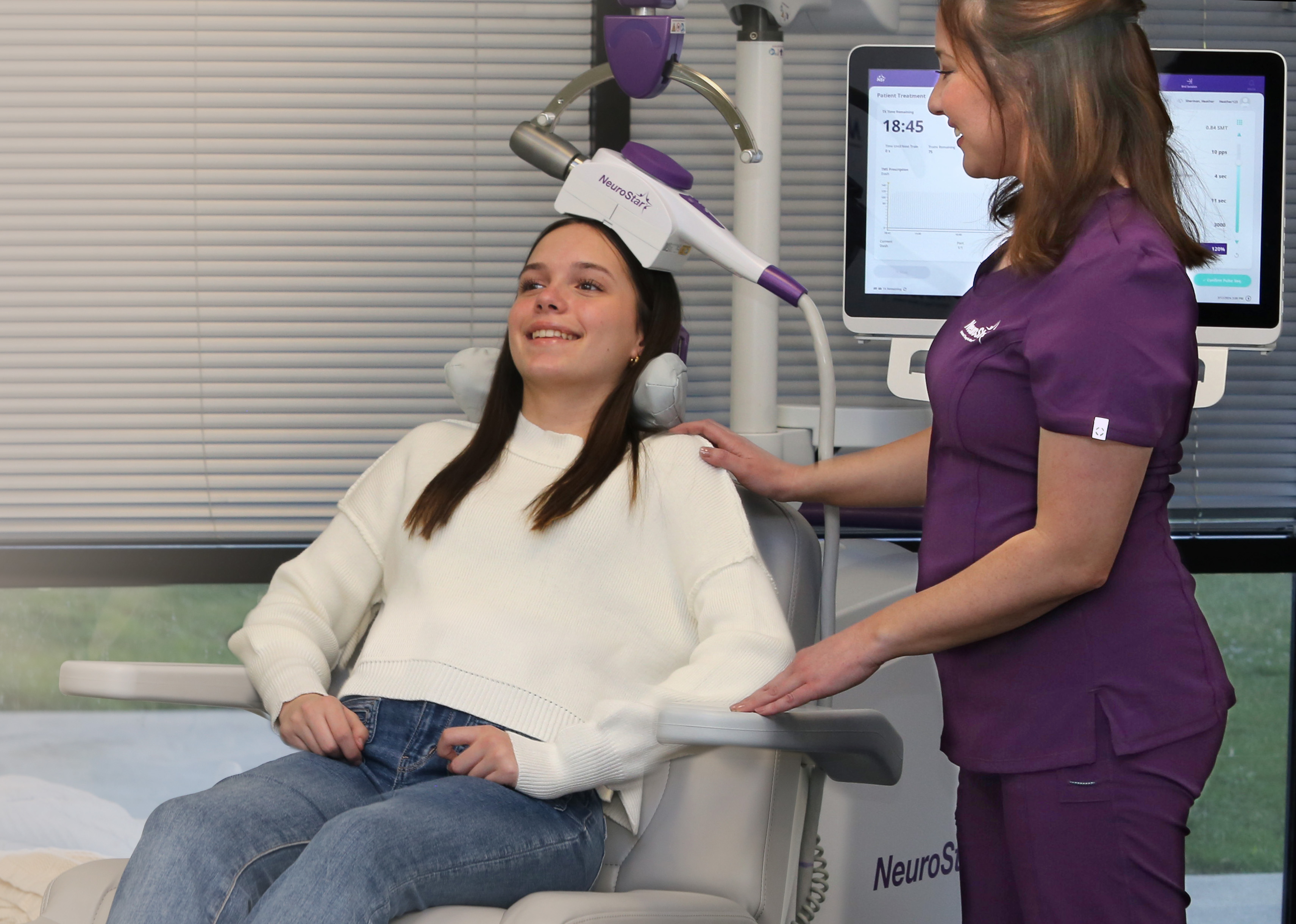
Each treatment session takes 3–20 minutes, depending on your protocol. You sit in our treatment chair, fully clothed, awake and alert. The NeuroStar coil rests gently against your scalp. You'll hear and feel a tapping sensation as the pulses fire. You can read, watch TV, talk, or just close your eyes. When the session ends, you stand up and walk out.
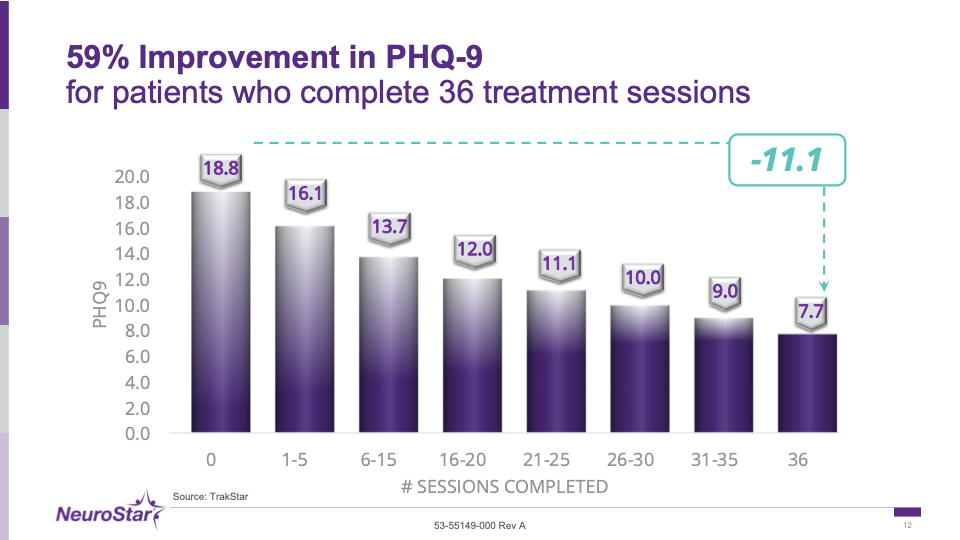
The full standard course is 36 sessions, 5 days per week. Most patients start to notice meaningful change between sessions 6 and 20 — long before the course ends, you'll have a sense of whether it's working. Your provider tracks symptom scores throughout and adjusts as needed.
Clinical research (Dunner 2014, Janicak 2010) shows durable benefit for many patients well past treatment completion. Some patients benefit from periodic maintenance sessions; others stay symptom-improved for months or years without any further treatment. We follow up at regular intervals to make sure your gains stick.
TMS recalibrates the brain's salience network and stimulates the prefrontal cortex directly. Ketamine triggers a burst of neuroplasticity and quiets the default mode network. The two treatments hit depression from complementary angles — and recent research (early 2026) suggests combining them produces significantly better outcomes than either treatment alone, especially for treatment-resistant depression, neuropathic pain, and substance use disorder.
If you're a candidate for both, ask your provider whether a combined protocol makes sense for you. We're one of the few clinics in Arizona offering both under one roof, which means coordinated treatment plans without referrals between practices.
If you don't see your question here, call us. We'd rather talk than have you leave with uncertainty.
Your first conversation is free, low-key, and staffed by people who actually know their stuff — and will tell you the truth, even if that means we're not the right fit.